
 buy
Land and farms for sale in Esslouguia
1 listing found
buyBrowse more property listings in the same area
Browse other popular searches in one click.
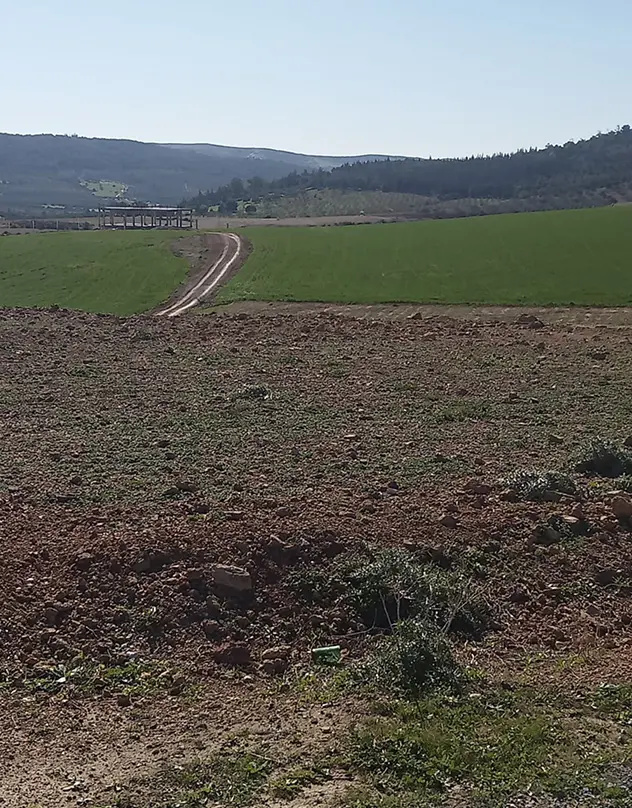
Esslouguia, which most people spell Slouguia, is a village in the Medjerda valley set on the road linking Medjez el-Bab to Testour. Like its neighbour, it is said to have Andalusian origins, and the centre has kept the feel of a farming town: a few streets around the mosque, low houses, cafés where talk turns to harvests and the price of wheat. All around, the plain opens onto fields as far as the eye can see, edged by hillsides planted with olive trees.
Land for sale in Slouguia is therefore almost always farmland, sold by a village family or by heirs who live elsewhere. Listings are rare and change from week to week. To widen the search to the town and the other sectors of the delegation, the page of land and farms for sale in Testour gathers the whole offer.
The land around the village
The valley floor mainly grows cereals, durum wheat and barley, along with fodder for livestock. These are heavy, fertile soils that give good yields in wet years. The slopes framing the plain are planted with olive trees, some old, some young, and that is where most of the plots that interest buyers from the capital are found.
Farms with buildings are few: a rural house, a shed, a well, sometimes a sheepfold. They sell at a quite different price level from bare land, and the state of the buildings weighs heavily in the negotiation. Alongside, a few plots on the edge of the village may be buildable, but they remain the exception.
Who buys, and what sets the price
Buyers are first of all valley farmers expanding their holdings. You also see families from the region, settled in Tunis or in Europe, who come back to buy land near their relatives, and city dwellers looking for an olive grove about an hour and a half from Tunis.
The price per hectare varies widely. Access to water makes the biggest difference: a plot within an irrigation scheme or with a licensed well is worth much more than dry land. Soil quality, slope, distance to a tarmac road and, for olive groves, the age and upkeep of the trees also count. Land in Slouguia generally trades at about the same level as in Testour, slightly higher when close to the main road.
Check before signing
Start with the land title. Much of the valley land belongs to several heirs, and a sale is only sound if they all sign. Part of the large holdings in the region also belongs to the State and cannot be sold: have the status checked at the land registry, then have the plot marked out by a surveyor.
Next come land use and water. You cannot build freely on farmland: if you are considering a house, ask the regional agricultural development office in Béja. For irrigation, ask which water rights come with the plot and whether any sums are still owed to the association that runs the network. Low-lying land near the river can be hit by Medjerda floods: the neighbours know which plots.
Visit in spring to judge the crops, in summer for the well. On Houni, you talk directly to the seller. To compare with Medjez el-Bab, Téboursouk or Béja, the land and farms for sale in the Béja governorate offer a broader picture.